my chronicle
|

|
|
 |
|
I Points of view on the artist
|
I Georges Rousse in situ
By Dominique Roussel, curator, Fine arts museum, Soissons France
Extract from « Georges Rousse », monograph edited by Fine arts museum, Soissons, 2005
In abandoned buildings across the world, before their destruction or their renovation,
Georges Rousse has worked and installed his darkroom for more than 20 years. He has set
up his nomad workshop in places into which he has infused new life and given it a new
history. As the artist himself likes to say, « ...I call upon various methods of art : I am the
designer of the project, the painter on-site, the architect by my interpretation of a given space
and by the construction I organise there within, and finally the photographer who coordinates
all these actions. »
Alone in these places destined to be lost into oblivion, he has chosen photography as the
artistic medium to put together an artwork, visible in its assembled state through his camera
lens at a fixed point. Early in his career, he painted figurative human shapes projected from
his dreams. Later, his work evolved towards the transformation of places by drawing,
painting, light manipulation, construction and deconstruction. New spaces were then created
by the effects of perspective, anamorphosis, and optical illusion. With his photography, going
from a three-dimensional space to a two-dimensional image disturbs one's visual perception
and embarks the mind on a voyage into the unreal, quite similar to what a painting does. The
complex relations between architecture, photography and painting are all revealed in the
calm and contemplative atmosphere of his sereine photographs.
|
|
|
|
|
|
|
|
I On the road with Georges Rousse
By Philippe Piguet, art critic, curator
Extract from « Georges Rousse », monograph edited by Fine arts museum, Soissons.
Texts Dominique Roussel and Philippe Piguet
Since he has entered the artistic scene 25 years ago, Georges Rousse has not ceased to
travel around the world in the way a fictitious character would stride across the globe over
plains, valleys and mountains as one would think to cross a street. This is someone who from
one day to the next finds himself at the other side of the planet and never leaving us a clue
about his whereabouts. In brief, he has made this world his own and never stops to circle it in
search of who knows what treasure. However, this man is not a hero from a legend, he is an
artist and photography is his artistic medium. Rousse's method quickly differentiates itself
from the simple click-click photography of his predecessors and readily qualifies as being
« artistic », followed by a rather well-researched fabrication process. [...]
For the past 25 years Georges Rousse has produced, as one would suspect, a considerable
number of pictures and his work has existed in all different types of composition. From a
figurative style to a clear geometric abstraction, from the use of certain patterns such as
words, textual excerpts, details from topographical maps, reproductions of buildings, etc., his
art reveals a tension between diverse antagonistic qualities. He employs both the distinct and
the indistinct, the known and the indescribable, the opaque and the transparent, the physical
and the metaphysical, shadows and light, and finally order and chaos. There is something
about the technique of Georges Rousse that simultaneously disorientates and fascinates the
viewer. It is something that has a lasting impact because it instills a sense of doubt within us.
[...] Always in pursuit of what the future holds, he is an open invitation to perpetually question
oneself and to seek for the eternally unattainable.
|
|
|
|
|
|
I Georges Rousse at Robert Mann Gallery - New York
This French artist's first solo exhibition in the United States included two photographs from
1997 of interiors transformed by geometric forms and eight works from 2000-01 suggesting
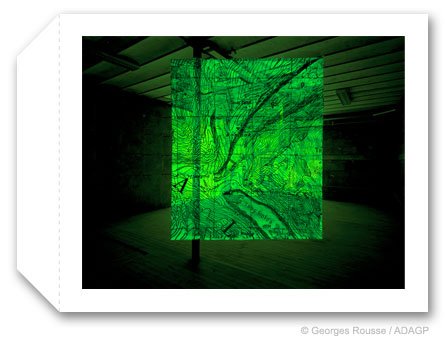
more cryptic interests. The latter, measuring approximately 5 by 4 or 4 by 5 feet, depict white
rooms manipulated by Rousse so that topographical maps, or abstract skeins of colored
lines, appear to lie on the foreground plane of the images.
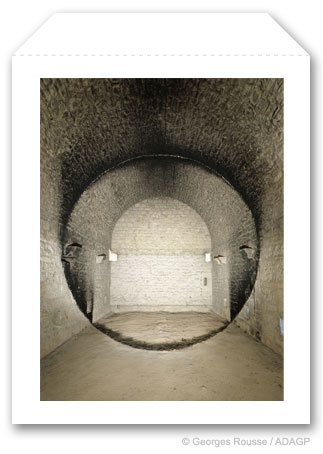
Rousse projects and paints these designs onto the rooms' multiple surfaces, then
photographs them from the precise position where the illusionistic images cohere. Moving
aside even one millimeter would disrupt the orthogonal program. He usually finds condemned
spaces to shoot; the titles refer to their geographic locations (Cologne, Turin, Berlin,
Fujiyama). However, the overlaid maps are of sites that the artist has visited in a different
capacity, on hikes in Nepal and the Far East.
Rousse's architectonic interventions combine Euclidean geometry with Robert Smithson's
challenge to gallery esthetics. It is important to view them as beautifully printed photographs.
But it is equally essential to see them as conceptual pieces, joining practice and theory.
Smithson's "Site/Non-Site" photographic works and "Mirror Displacements" (where the actual
works were located outside the gallery and not visible to viewers) come to mind, but Rousse
elides the tension between gallery and subject--the artist's interventions are removed after
they are documented. They exist only in these prints.
Clermont-Ferrand depicts an interior located somewhere in the capital of Auvergne and
features a map of Tsho Rolpa, a glacial lake in the Rolwaling area of Nepal. The map, which
is black with white markings, hovers magically in space as a transparent plane. Junctions are
carefully calculated in this work where the left and right edges of the map join the vertical
supports of flanking archways. Here, and in other pieces, topographically erratic lineations of
the maps clash with the simple vaulted or perpendicular surfaces of the architecture. Many of
the rooms include windows that provide a poetic ambient light, perhaps as a reference to the
outside world represented by the maps.
It is Ironic that Rousse painstakingly crafts works that in their multilayered illusions initially
appear digitally modified. Is he playing with today's expectations of contemporary
photography? Rousse's complex method is often visually confusing, but elegant examples
like Clermont-Ferrand.
draw the viewer in. This particular work employs perspective and a classical sense of
symmetry to effectively convey the power of the artist's ideas.
Defying categorization, the best of Rousse's works imprint maps of wild terrain on degraded
spaces of human interaction. They are records of mapping, entropy and time, as well as an
artistic process elucidated with considerable visual style.
Jason Rosenfeld
Art in America, november 2002
|
|
|
|
|
|
|
|
|
|
I In the art: critics' choices, photography
Is it possible to make a Neo-Expressionist photograph? Georges Rousse, a young French
artist currently living in New York, gives it a go in an exhibition at the Zabriskie Gallery, 724
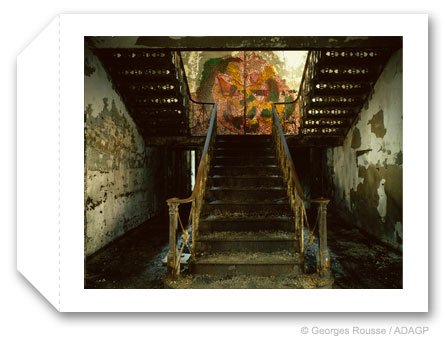
Fifth Avenue. Mr. Rousse's large (4-by-5-foot) color pictures record the ''additions'' he has
made to the inside walls of derelict buildings - primitive, mosaic-like paintings in which lurk
huge and slightly ominous figures. Each painting consists of thousands of small patches,
each of which bears a number; the effect is much like a child's coloring book.
In part, then, Mr. Rousse's images are obsessively Expressionist in a manner that brings to
mind Jonathan Borofsky's drawings, and in part, they are documents of artistic activity
occurring in remote locations, in the tradition of Robert Smithson and Gordon Matta-Clark.
But they also are interesting as photographs. This is because Mr. Rousse makes his
paintings in photographic perspective - that is, his figures and backgrounds appear in the
images as if on a flat surface, even though they have been painted in corners and stairways
and the like. There is a delightful sense of play here, like that found in the photographs of
John Divola and John Pfahl. Obviously, Mr. Rousse's work is in debt to a great many artists,
but the way in which he has combined his sources is pleasurably unique. The exhibition,
which includes works by two other French artists, can be seen through Sept. 10
Andy Grundberg
The New York Times, August 7, 1983
|
|
|
|
|
|
|
|
|
|
|

|
|